I’m an “agent" now? I must be important...
I forgot to cross-post here... I wrote a thing about "code design," it's a little snarky but hopefully not too much so:
I forgot to cross-post here... I wrote a thing about "code design," it's a little snarky but hopefully not too much so:


public class Employee {
  private Date startDate;

  public Integer monthsOnJob() {
    Integer months = 0;
    // Do the math
    return months;
  }

  public String jobDescription() {
    return "New employee"; // Default description, will be overriden by subclasses
  }
}
public class Developer extends Employee {

  @Override
  public String jobDescription() {
    return "Developer: " + listTechnicalSkills();
  }

  private String listTechnicalSkills() {
    String skillStr = "";
    // TODO get skills from getTechnicalSkills and build string
    return skillStr;
  }

  private Collection technicalSkills;

  public Collection getTechnicalSkills() {
    return technicalSkills;
  }

  public void setTechnicalSkills(Collection technicalSkills) {
    this.technicalSkills = technicalSkills;
  }
}
public class Manager extends Employee {
  Collection reports;

  @Override
  public String jobDescription() {
    return "Suit";
  }

  public Collection<Employee> getReports() {
    return reports;
  }
}
class Employee
  attr_accessor :start_date # method that creates accessors

  def initialize(start)
    @start_date = start
  end

  def months_on_job
    # Math is easy
    (Date.today.year*12 + Date.today.month) - (@start_date.year*12 + @start_date.month)
  end

  def job_description
    "New employee"
  end

end
class Developer < Employee

  attr_accessor :technical_skills

  def initialize(start)
    super(start)
    @technical_skills = []
  end

  def job_description
    ret = "Developer: "
    @technical_skills.each {|skill| ret << " ${skill"}
  end

end
class Manager < Employee

  attr_accessor :reports # accessor
  def initialize(start)
    super(start)
    @reports = []
  end

  def job_description
    "Suit"
  end

end
My Resume describes my skills in much more detail. I'd love to make your development project a huge success, drop me a line if you are interested.
- John

...traditional process management—by continuous measurement, error identification, and process refinements—strove to drive variations out of processes. This approach assumes that variations are the result of errors. Today, while process problems certainly cause some errors, external environmental changes cause critical variations. Because we cannot eliminate these changes, driving down the cost of responding to them is the only viable strategy. Rather than eliminating rework, the new strategy is to reduce its cost.
[NOTE: I think he means code rework--Big Up-Front planning and design will result in more rework of other work products, assuming the effort is not wasted entirely as these products are abandoned.]
Business needs, priorities, understanding of user needs, expertise with the
technical platform, market forces, and available technologies... All of these
can and usually do change over the life of a project. Agile management rolls
with these changes and capitalizes on them to make the best software possible.
Smart project sponsors can use agile management to build better software for
less money.
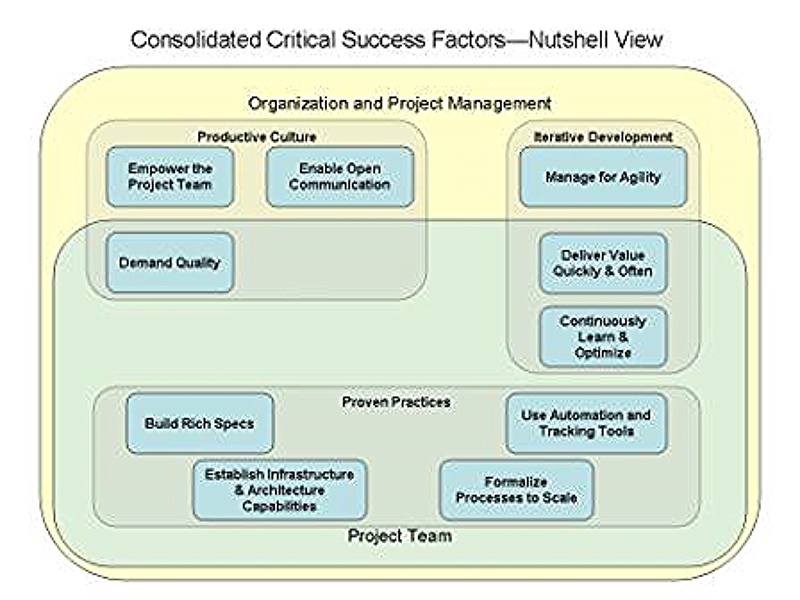
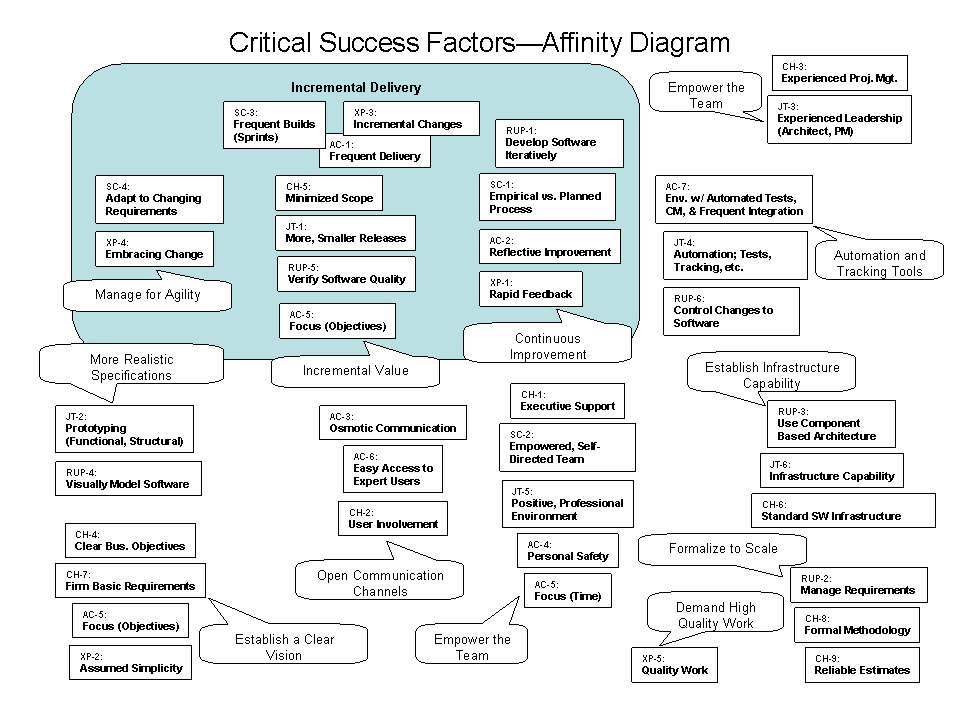
Yes, it's a catch-22 situation: Managers have to accept that reality. Managers must embrace change, accept the empirical nature of the software development process, and stop trying to do all the planning and specification work up-front. Companies still trying to use linear, silo'd, paper-heavy methods for Web-based apps are dead, whether they realize if or not. To increase productivity, and reduce costs and time-to-market, managers must truly understand and utilize Agile management. I personally think that Alistair Cockburn's work on Agile development is the most comprehensible. Scrum is perhaps the best overarching management view, and XP provides a system of proven team practices.
Another project management "move" that can greatly reduce development cycle times is rapid prototyping. Simply put, exploring and defining requirements with documents is a relatively poor way of getting the system right. More productive projects user "richer" media for definition and validation, and the richest vehicle is a working prototype. For example, a team can develop a Ruby on RAILs prototype to quickly and cheaply explore and validate the functional requirements. Another powerful option for rapid prototyping and validation is Gorilla Logic.SELECT *
FROM (SELECT ROWNUM RNUM, INLINE_VIEW.* FROM(
your-select
your-where
and key-or-order-by-field > lower-boundary
[order by order-by-field]
) INLINE_VIEW
)
WHERE RNUM < max-range
