After 3.5 years with Rearden, I decided to go back to freelancing, for the 3rd time.
This time around I am going by codecraft solutions. I am presently subing with Marty Haught and intend to continue for some time. Eventually though I intend to run my own projects too.
That's the plan, stay tuned.
Monday, October 24, 2011

Wednesday, September 20, 2006
What's So Great About Rails?
OK, so now I guess I am becoming a "Rails Guy." At least, I have been doing some Ruby on Rails programming lately and am generally very impressed.
It is still Web programming, there are no major paradigm shifts here. However, Ruby on Rails is an example of how a lot of little things done right can really add up. Ruby is a fine scripting language, improving upon popular languages like Perl and Python. And Rails is an example of getting the little details of Web programming right. Rails is optimized (as I see it) for (1) Productivity and (2) Maintainability. The following are what I really like:
So I do like Rails a lot, I think it is probably the best solution for many small-medium sized webapps. But it is not necessarily a replacement for Java, especially in the enterprise. The trick is for decision-makers to weight their needs for big E Enterprise requirements against speed and simplicity.
It is still Web programming, there are no major paradigm shifts here. However, Ruby on Rails is an example of how a lot of little things done right can really add up. Ruby is a fine scripting language, improving upon popular languages like Perl and Python. And Rails is an example of getting the little details of Web programming right. Rails is optimized (as I see it) for (1) Productivity and (2) Maintainability. The following are what I really like:
- The clean, simple ActiveRecord ORM layer.
- A full-fledged yet simple MVC that is easy to comprehend and get around in.
- Sensible defaults and very little configur-bation; "convention over configuration."
- A good job of making the most common tasks simple; the 80/20 rule.
- "rake migrate" is the coolest way to manage schemas that I have seen.
So I do like Rails a lot, I think it is probably the best solution for many small-medium sized webapps. But it is not necessarily a replacement for Java, especially in the enterprise. The trick is for decision-makers to weight their needs for big E Enterprise requirements against speed and simplicity.
Tuesday, September 19, 2006
Productive Editing and Eclipse
I went to a great presentation by Neal Ford last week at the DJUG, entitled the Productive Programmer. Neal is a sharp guy, a good speaker, and a solid thinker on improving productivity. Go ahead and CRTL-Enter nealford in your address bar to check out his site (you'll see what I mean).
The talk was a bit of a wake-up for me. His premise is that the rise of the IDE has made programmers, well, lazy (my words, I don't think he went so far). I realized that I have let some old but valuable skills languish in the past few years. So Neal's talk has inspired me to sharpen the saw back up. For example, I have made the decision that Ruby will be my scripting power tool moving forward (used to be Perl), and I will not shy away from opportunities to explore automation (even if it is initially just exercise).
Another point that resonated with me was the idea of the "perfect" editor. I do think that I am now as productive over all in Eclipse as I used to be in Emacs (with a side trip through NetBeans). But Neal hit on two things that are missing: Multiple cut/paste buffers (kill-loop in Emacs) and editor scripting. Though I am intrigued by the lightweight JEdit, I am determined to stay in Eclipse and make the best of it. I think that surely these two deficiencies can be addressed.
On the multiple buffers front, I quickly came up with an answer that works for me: CLCL. This tool is actually a utility that caches your Windows clipboard. So CRTL-C still works like normal, but you can also reach back in time and paste something from 30 cuts ago. Sounds trivial, but it can change the way you edit.
As for the scripting integration, I haven't looked very far. Prashant Rane's blog led me to Eclipse Monkey, which looks interesting--it's Javascript, which I can defnitely code. I might keep looking, though, for something that provides editor hooks for Ruby, Groovy, or BeanShell. I'll post again if I find the silver bullet.
The talk was a bit of a wake-up for me. His premise is that the rise of the IDE has made programmers, well, lazy (my words, I don't think he went so far). I realized that I have let some old but valuable skills languish in the past few years. So Neal's talk has inspired me to sharpen the saw back up. For example, I have made the decision that Ruby will be my scripting power tool moving forward (used to be Perl), and I will not shy away from opportunities to explore automation (even if it is initially just exercise).
Another point that resonated with me was the idea of the "perfect" editor. I do think that I am now as productive over all in Eclipse as I used to be in Emacs (with a side trip through NetBeans). But Neal hit on two things that are missing: Multiple cut/paste buffers (kill-loop in Emacs) and editor scripting. Though I am intrigued by the lightweight JEdit, I am determined to stay in Eclipse and make the best of it. I think that surely these two deficiencies can be addressed.
On the multiple buffers front, I quickly came up with an answer that works for me: CLCL. This tool is actually a utility that caches your Windows clipboard. So CRTL-C still works like normal, but you can also reach back in time and paste something from 30 cuts ago. Sounds trivial, but it can change the way you edit.
As for the scripting integration, I haven't looked very far. Prashant Rane's blog led me to Eclipse Monkey, which looks interesting--it's Javascript, which I can defnitely code. I might keep looking, though, for something that provides editor hooks for Ruby, Groovy, or BeanShell. I'll post again if I find the silver bullet.
Thursday, April 27, 2006
Shameless Promotion 4: Rapid, Affordable Application Development
I am available to help Clients develop applications cheaply and quickly, applications that help them to reach more customers and reduce costs. I can help clients use the Web to make breakthroughs in marketing, sales, and operations.
I have built dozens of successful applications for the Web and other environments. I can provide hands-on expertise across the software development lifecycle: from strategy and requirements to architecture and design to development and testing. I also provide project management and "general contractor" services, so I can bring the right talent to the table for most any web development project.
The following is a quick summary of the skills and capabilities I provide to help you achieve robust solutions quickly and at affordable rates:
I have built dozens of successful applications for the Web and other environments. I can provide hands-on expertise across the software development lifecycle: from strategy and requirements to architecture and design to development and testing. I also provide project management and "general contractor" services, so I can bring the right talent to the table for most any web development project.
The following is a quick summary of the skills and capabilities I provide to help you achieve robust solutions quickly and at affordable rates:
- Experience in online communication, eCommerce, and improving efficiencies.
- Technical lead, architect, and developer experience on dozens of projects, including complex applications for Sheraton Hotels, Travelocity, Budget Rent-A-Car, and the Veteran's Administration.
- Programming experience in Java (5+ years), C (3), VB/ASP (3), Perl (2), and lately Ruby.
- Effective, hands-on skills as a software engineer, architect, and business/systems analyst.
- MBA and a Bachelor's in Computer Science.
- Extensive network of software and Design professionals for general contracting services.
- Very competitive rates, for myself and subcontractors.
My Resume describes my skills in much more detail. I'd love to make your development project a huge success, drop me a line if you are interested.
- John
Wednesday, April 26, 2006
Software Success Factor #1: Manage for Agility UPDATED
The ability of an organization to Manage for Agility is one of the most important success factors for modern software development. This factor encompasses the critical role that Management--or the project Client or Sponsor--plays in Iterative Development. In this post, I will attempt to address what this factor entails and how it is accomplished. I will also briefly recap why this management style is superior. I have yet to complete the Overview of the Reference Model, but Agile Management is so important that I wanted to flesh out this success factor first.
What
Iterative development is perhaps the key attribute of modern software success, but without management support it is impossible. To manage for agility, leaders must go against many traditional management styles and ingrained practices. It is a natural for successful business people to try to avoid future change through detailed planning and up-front analysis, but changes are inevitable. Trusting the team and the process to produce the best solution, allowing the scope, the design, and even the process to emerge, is what it means to Manage for Agility.
How
To manage agile projects, sponsors must resist the desire to plan and design the entire project before starting any development. To be agile, management must instead embrace a flexible model that responds to changing requirements and an evolving understanding of the solution. Management must trust the process and the team to produce top quality software, without a relying on a rigid scope.
Often it is the "commercial Model," contracts, SOWS, etc., that most influences the interaction between management and the project team. To manage for agility, the commercial model must provide for evolving scope and design. Put another way, attempting to fix the scope in agreements up-front is simply at odds with an agile style. When using consultants or contractors, a Time-And-Materials approach allows for the most agility, or the agreement can employ separate SOWs created at the start of each iteration. Another approach offered by Kent Beck is the use of "Optional Scope Contracts."
It is also important to understand that agile does not mean that no planning or requirements are done up front. The project still needs a first cut at the inventory of requirements--e.g. a Scrum backlog or a Use-case survey--that is the source from which iteration requirements are selected, refined, and built. An agile project can also develop a detailed, "pro-forma" project plan, but managers should not feel compelled to stick to the original as the team adjusts to accumulating change.
Why
Why should managers buy into this approach, when traditional project management techniques have worked on all kinds of projects, from construction to aerospace engineering? Because software development is fundamentally different from construction or engineering, and treating it like these disciplines magnifies the risk of failure, raises costs, and produces worse software.
Change is unavoidable in Software Development, more so than most any field. Alan Shalloway made the claim, at a recent Agile Denver meeting, that software development is not like building a bridge; it is more like building the first bridge... or the design phase of a bridge project. An analogy is also often drawn between construction and software development. However, many experts claim that software development is essentially all design work, and the only step that is really like construction is the compile/build cycle.
The highly successful Scrum process is based on proven new-product development processes used by Japanese companies. Indeed, the Scrum proponents and many others have claimed, accurately I believe, that software development is very like new product development. If we look at software development as roughly analogous to the design and development of a new kind of car, or a new consumer electronics gadget, it becomes clear that the nature of the process is unpredictable and should be managed accordingly. Agile management uses an empirical process management approach to produce a better product. One need look no further for evidence than the difference between American cars and Japanese, at least until very recently.
Alistair Cockburn expands on the idea of "responding to change over following a plan:"
What

Iterative development is perhaps the key attribute of modern software success, but without management support it is impossible. To manage for agility, leaders must go against many traditional management styles and ingrained practices. It is a natural for successful business people to try to avoid future change through detailed planning and up-front analysis, but changes are inevitable. Trusting the team and the process to produce the best solution, allowing the scope, the design, and even the process to emerge, is what it means to Manage for Agility.
How
To manage agile projects, sponsors must resist the desire to plan and design the entire project before starting any development. To be agile, management must instead embrace a flexible model that responds to changing requirements and an evolving understanding of the solution. Management must trust the process and the team to produce top quality software, without a relying on a rigid scope.
Often it is the "commercial Model," contracts, SOWS, etc., that most influences the interaction between management and the project team. To manage for agility, the commercial model must provide for evolving scope and design. Put another way, attempting to fix the scope in agreements up-front is simply at odds with an agile style. When using consultants or contractors, a Time-And-Materials approach allows for the most agility, or the agreement can employ separate SOWs created at the start of each iteration. Another approach offered by Kent Beck is the use of "Optional Scope Contracts."
It is also important to understand that agile does not mean that no planning or requirements are done up front. The project still needs a first cut at the inventory of requirements--e.g. a Scrum backlog or a Use-case survey--that is the source from which iteration requirements are selected, refined, and built. An agile project can also develop a detailed, "pro-forma" project plan, but managers should not feel compelled to stick to the original as the team adjusts to accumulating change.
Why
Why should managers buy into this approach, when traditional project management techniques have worked on all kinds of projects, from construction to aerospace engineering? Because software development is fundamentally different from construction or engineering, and treating it like these disciplines magnifies the risk of failure, raises costs, and produces worse software.
Change is unavoidable in Software Development, more so than most any field. Alan Shalloway made the claim, at a recent Agile Denver meeting, that software development is not like building a bridge; it is more like building the first bridge... or the design phase of a bridge project. An analogy is also often drawn between construction and software development. However, many experts claim that software development is essentially all design work, and the only step that is really like construction is the compile/build cycle.
The highly successful Scrum process is based on proven new-product development processes used by Japanese companies. Indeed, the Scrum proponents and many others have claimed, accurately I believe, that software development is very like new product development. If we look at software development as roughly analogous to the design and development of a new kind of car, or a new consumer electronics gadget, it becomes clear that the nature of the process is unpredictable and should be managed accordingly. Agile management uses an empirical process management approach to produce a better product. One need look no further for evidence than the difference between American cars and Japanese, at least until very recently.
Alistair Cockburn expands on the idea of "responding to change over following a plan:"
...traditional process management—by continuous measurement, error identification, and process refinements—strove to drive variations out of processes. This approach assumes that variations are the result of errors. Today, while process problems certainly cause some errors, external environmental changes cause critical variations. Because we cannot eliminate these changes, driving down the cost of responding to them is the only viable strategy. Rather than eliminating rework, the new strategy is to reduce its cost.
[NOTE: I think he means code rework--Big Up-Front planning and design will result in more rework of other work products, assuming the effort is not wasted entirely as these products are abandoned.]
Business needs, priorities, understanding of user needs, expertise with the
technical platform, market forces, and available technologies... All of these
can and usually do change over the life of a project. Agile management rolls
with these changes and capitalizes on them to make the best software possible.
Smart project sponsors can use agile management to build better software for
less money.
Friday, April 14, 2006
The Software Success Reference Model - Overivew
Here, again, is my Reference Model: a 30,000 ft. view of software success. This post will provide an overview of the categories from the model--sort of a taxonomy of success. See my previous post for more information on how I derived this model.
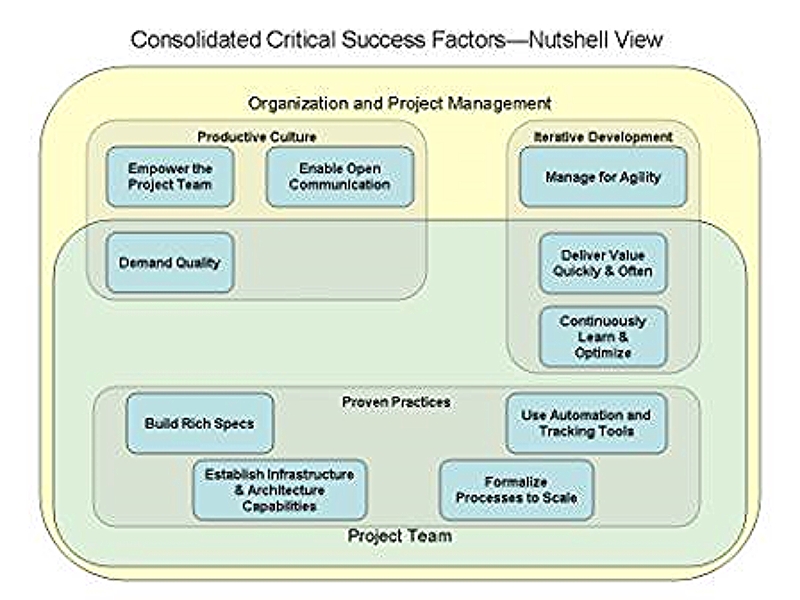
Groupings
Organization and Project Management
Perhaps this should be entitled simply Organization and Management. This grouping deals with factors that are beyond the scope of any project team--organization and management at the highest levels.
Project Team
These factors deal more specifically with the project team involved directly with producing the software.
Iterative Development
This category contains factors that relate to producing software in an iterative, incremental, adaptive manner.
Productive Culture
Factors dealing with the kind of people the Organization employs and how the Organization fosters a culture that promotes productivity.
Productive Practices
Specific practices that help the Project Team develop software efficiently.
Software Engineering (for Large Projects)
Factors necessary for projects with a large number of developers and/or critical consequences of failure.
Factors
Manage for Agility
This factor encompasses the critical role that Management--or the Client--plays in Iterative Development. Leadership must be willing to launch a project without detailed plans or specs, and trust the team and the process. Further, project clients must realize that the agile approach is a Good Thing, allowing the team to respond nimbly to a changing world, and producing more relevant software in less time.
Deliver Value Quickly & Often
Another aspect of Iterative Development, this factor focuses on the ultimate goal of software development: working software. Teams must focus on producing working software from the very first iteration, and keeping implementation as relevant to the needs as possible by avoiding unnecessary interim work products and long time lags.
Continuously Learn & Optimize
The final component of Iterative Development is the concept of continuous improvement. Iterations afford the team with the opportunity to exercise all lifecycle activities in short bursts. This means they can reflect, learn, and optimize their process and practices with each cycle.
Empower the Project Team
Also solely in the Management arena, the client of the project must provide the project team with the tools, resources, and support necessary to succeed. As much as possible, the team must be allowed to organize and direct itself however necessary to deliver the requirements.
Enable Open Communication
Software development is inherently a team design activity. Communicating ideas and building a shared mental model of the solution are critical. Organizations must strive to achieve "osmotic" communication, provide access to experts, and involve users throughout the process.
Demand Quality
Teams must develop a high standard of quality as a norm, and internalize quality validations within the team, rather than "throwing" code "over the wall."
Use More Realistic Specification(s)
Just as a picture is worth a thousand words, the richer, higher-fidelity one can achieve in software specifications the better. Teams should use mock-ups, prototypes, and visual models as much as possible, while still constraining specification to whatever is "minimally sufficient" for the current increment.
TODO: Software Engineering factors
Groupings
Organization and Project Management
Perhaps this should be entitled simply Organization and Management. This grouping deals with factors that are beyond the scope of any project team--organization and management at the highest levels.
Project Team
These factors deal more specifically with the project team involved directly with producing the software.
Iterative Development
This category contains factors that relate to producing software in an iterative, incremental, adaptive manner.
Productive Culture
Factors dealing with the kind of people the Organization employs and how the Organization fosters a culture that promotes productivity.
Productive Practices
Specific practices that help the Project Team develop software efficiently.
Software Engineering (for Large Projects)
Factors necessary for projects with a large number of developers and/or critical consequences of failure.
Factors
Manage for Agility
This factor encompasses the critical role that Management--or the Client--plays in Iterative Development. Leadership must be willing to launch a project without detailed plans or specs, and trust the team and the process. Further, project clients must realize that the agile approach is a Good Thing, allowing the team to respond nimbly to a changing world, and producing more relevant software in less time.
Deliver Value Quickly & Often
Another aspect of Iterative Development, this factor focuses on the ultimate goal of software development: working software. Teams must focus on producing working software from the very first iteration, and keeping implementation as relevant to the needs as possible by avoiding unnecessary interim work products and long time lags.
Continuously Learn & Optimize
The final component of Iterative Development is the concept of continuous improvement. Iterations afford the team with the opportunity to exercise all lifecycle activities in short bursts. This means they can reflect, learn, and optimize their process and practices with each cycle.
Empower the Project Team
Also solely in the Management arena, the client of the project must provide the project team with the tools, resources, and support necessary to succeed. As much as possible, the team must be allowed to organize and direct itself however necessary to deliver the requirements.
Enable Open Communication
Software development is inherently a team design activity. Communicating ideas and building a shared mental model of the solution are critical. Organizations must strive to achieve "osmotic" communication, provide access to experts, and involve users throughout the process.
Demand Quality
Teams must develop a high standard of quality as a norm, and internalize quality validations within the team, rather than "throwing" code "over the wall."
Use More Realistic Specification(s)
Just as a picture is worth a thousand words, the richer, higher-fidelity one can achieve in software specifications the better. Teams should use mock-ups, prototypes, and visual models as much as possible, while still constraining specification to whatever is "minimally sufficient" for the current increment.
Use Automation and Tracking Tools
The value of SCM, task & issue tracking, automated tests, etc. is well established. Just do it.TODO: Software Engineering factors
Thursday, March 02, 2006
Software Development Success Reference Model - Background
What does it take to run a successful software development project? Success does not come easy, but it can be done. The industry has many success stories, and software development thought leaders have identified the key principles that lead to success. But what are the critical success factors, and what principles find common ground among the experts?
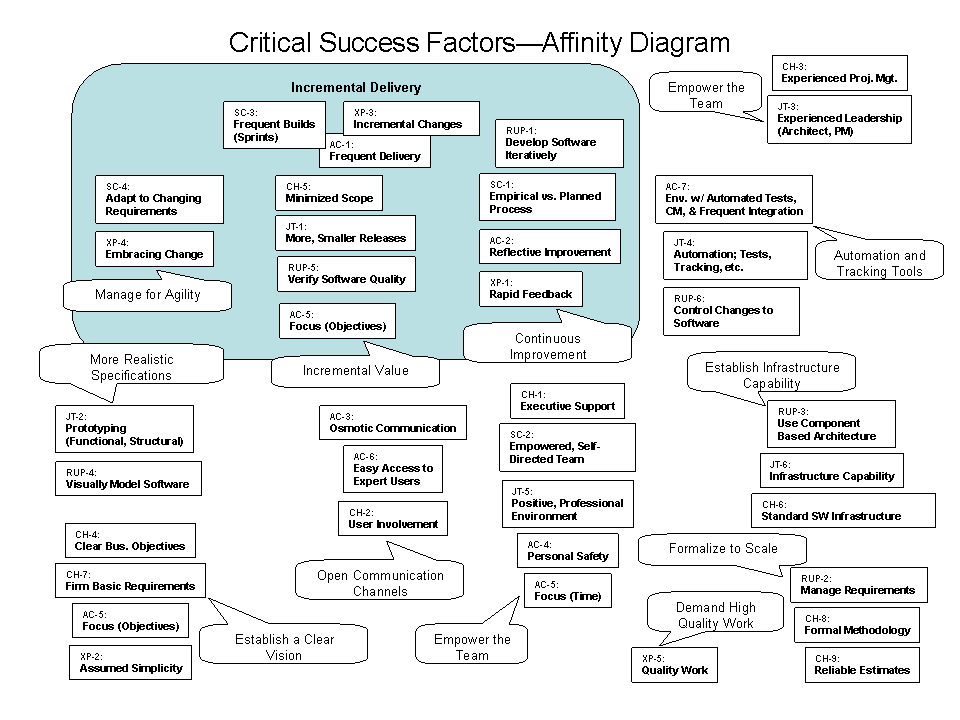
About 6 months ago, I started trying to create a set of success factors that were synthesized from the experts. I have since completely revamped my thoughts. What I ultimately want, for my own purposes, is a "Reference Model" (e.g. the OSI 7-Layer Model) that provides some structure with which I can I can think and talk about the various factors that lead to success--independent of any specific methodologies. I hope to be able to say things like "Reflection Workshops in Crystal are one technique to Continuously Learn and Optimize," or "XP provides a system for Iterative Development and Proven Practices, focused on smaller Project Teams."
I have now spent some more time thinking, and included some more popular, respected sources. The following slide is my Reference Model, a 30,000 ft. view of software success.
In future posts, I will provide more details on the individual success factors and how they relate to the work of industry luminaries. So, how did I arrive at this model? I started by taking the most important, highest-level principles and factors from the following excellent resources:
Comments are most welcome.
About 6 months ago, I started trying to create a set of success factors that were synthesized from the experts. I have since completely revamped my thoughts. What I ultimately want, for my own purposes, is a "Reference Model" (e.g. the OSI 7-Layer Model) that provides some structure with which I can I can think and talk about the various factors that lead to success--independent of any specific methodologies. I hope to be able to say things like "Reflection Workshops in Crystal are one technique to Continuously Learn and Optimize," or "XP provides a system for Iterative Development and Proven Practices, focused on smaller Project Teams."
I have now spent some more time thinking, and included some more popular, respected sources. The following slide is my Reference Model, a 30,000 ft. view of software success.
In future posts, I will provide more details on the individual success factors and how they relate to the work of industry luminaries. So, how did I arrive at this model? I started by taking the most important, highest-level principles and factors from the following excellent resources:
- The Standish Group's CHAOS study [CH1..9]
- The Unified Process or RUP [RUP-1..6]
- The SCRUM meta-process (web, book) [SC-1..4]
- Alistair Cockburn and Crystal methods (web, book, book) [AC-1..7]
- eXtreme Programming (web, web, book) [XP-1..5]
- My own experience on dozens of successful projects [JT-1..6]
Comments are most welcome.
Wednesday, January 11, 2006
New Frontiers of Enterprise Java Development
I've been thinking lately about trends in enterprise software development, especially in the Java world. Overall, what I see is a change in priority for enterprise software projects: from struggling not to fail completely, to actually excelling and competing. The latest technology and tools, along with modern "Agile" development methods, enable companies to really compete on quality and functionality, efficiency and productivity. Smart development organizations can not only avoid failure, but deliver better software more efficiently.
Background:
In the mid-90s, the ubiquitous distribution and instant maintenance capabilities of Web-based applications pushed them to the forefront. When applications moved beyond brochure-ware, a significant problem arose: Teams developing Web-apps could not readily achieve the enterprise requirements, or qualities, necessary for success: performance, scalability, security, etc. So, most of the effort and money spent by development teams went to achieving the necessary enterprise qualities.
Teams also struggled with process in the 90s, and to a large extent still do. The fast and loose style of early Web development did not work for mission critical apps, and traditional Methodologies did not work for Web teams. Furthermore, I think the frenetic rate of business and technical change finally killed the notion of viability of traditional, waterfall processes, at least for shops that "got it. "
By the late 90s, the major Web application platforms, like J2EE and compliant app. Servers, made it practical to address Enterprise requirements--although not easy or efficient. In addition, the effects of Moore's Law have made it much cheaper to throw more hardware at a solution, reducing the effort involved to handle the scale of enterprise apps. At the same time, Agile project management approaches began to gain visibility, blending the engineering-like discipline with the creative nature of software development.
In 2006, I contend, the development tools and frameworks for Web development have largely caught up to the platforms. Creating a robust, scalable, enterprise app no longer necessitates an army of J2EE coders rolling EJBs by hand. Looking forward, ISVs and IT shops just don't have to focus as much on addressing enterprise requirements*. Nor do teams need to struggle with heavy Methodologies--there are new mountains to climb. It is time for Web application development to grow up and act like "real" product development.
Competing with Agile Project Management:
Today, I think any manager who doesn't at least vaguely acknowledge the benefits of an Iterative or Agile project management approach has been hiding under a rock for several years. Some managers even claim to use these approaches, although few really do it right. Just because a team breaks up the coding for a project into increments, doesn't mean that they are Agile.
To improve productivity with process, management must get away from the compulsion to scope, define, and plan the entire project up front. Rather, they must accept and embrace two essential facts:
The working prototype provides much more comprehensible, complete, and unambiguous information than stacks of documentation, which saves a ton of wasted work downstream. If one accepts that an iteration or increment can be thrown away, then prototyping fits very nicely with Agile methods.
Though not strictly a project management move, I also think that automation has tremendous potential to make teams more competitive. That will be the subject for another post. For now, I will simply say that I think that XDoclet is definitely a tool that teams should look at using and extending... and MDA tools like AndroMDA show some potential as well.
Competing with Richer User Interfaces
Along with the powerful distribution and update benefits of the Web came with a catch: The capabilities of a browser-based interface, though often visually attractive, are weak. Things like tree browsers, master-detail views, and fine control over interface widgets have generally been painful to achieve. Teams did not have time to work around these issues, and the user experience suffered.
Now that the technologies are available that help to take care of enterprise issues with much less effort, teams can make there applications better with richer user interfaces. AJAX, a technique for making asynchronous HTTP requests in the javascript for a page, seems to be a very hot technology of late. For applications that require a highly graphical look and feel, along with better usability, Macromedia Flex is strong player. But the next great client platform, I believe, is Eclipse RCP.
*NOTE: I also think that tools Ruby on RAILS, PHP, ColdFusion, etc. might now present a viable challenge to J2EE and .NET in the Enterprise space, with the right hardware.
**NOTE: I really don't have a feel for what is going on in the Microsoft/.NET world. However, to their credit, I think Microsoft has always focused more on productivity than on Enterprise requirements (e.g. VB). How successful they have been on this front is a matter of debate.
Background:
In the mid-90s, the ubiquitous distribution and instant maintenance capabilities of Web-based applications pushed them to the forefront. When applications moved beyond brochure-ware, a significant problem arose: Teams developing Web-apps could not readily achieve the enterprise requirements, or qualities, necessary for success: performance, scalability, security, etc. So, most of the effort and money spent by development teams went to achieving the necessary enterprise qualities.
Teams also struggled with process in the 90s, and to a large extent still do. The fast and loose style of early Web development did not work for mission critical apps, and traditional Methodologies did not work for Web teams. Furthermore, I think the frenetic rate of business and technical change finally killed the notion of viability of traditional, waterfall processes, at least for shops that "got it. "
By the late 90s, the major Web application platforms, like J2EE and compliant app. Servers, made it practical to address Enterprise requirements--although not easy or efficient. In addition, the effects of Moore's Law have made it much cheaper to throw more hardware at a solution, reducing the effort involved to handle the scale of enterprise apps. At the same time, Agile project management approaches began to gain visibility, blending the engineering-like discipline with the creative nature of software development.
In 2006, I contend, the development tools and frameworks for Web development have largely caught up to the platforms. Creating a robust, scalable, enterprise app no longer necessitates an army of J2EE coders rolling EJBs by hand. Looking forward, ISVs and IT shops just don't have to focus as much on addressing enterprise requirements*. Nor do teams need to struggle with heavy Methodologies--there are new mountains to climb. It is time for Web application development to grow up and act like "real" product development.
Competing with Agile Project Management:
Today, I think any manager who doesn't at least vaguely acknowledge the benefits of an Iterative or Agile project management approach has been hiding under a rock for several years. Some managers even claim to use these approaches, although few really do it right. Just because a team breaks up the coding for a project into increments, doesn't mean that they are Agile.
To improve productivity with process, management must get away from the compulsion to scope, define, and plan the entire project up front. Rather, they must accept and embrace two essential facts:
- Needs and requirements will change constantly during the project; and
- User needs, technological pitfalls, and team capabilities will never be adequately or accurately understood until the team has gone through the complete lifecycle with one or more slices of the working system.
Yes, it's a catch-22 situation: Managers have to accept that reality. Managers must embrace change, accept the empirical nature of the software development process, and stop trying to do all the planning and specification work up-front. Companies still trying to use linear, silo'd, paper-heavy methods for Web-based apps are dead, whether they realize if or not. To increase productivity, and reduce costs and time-to-market, managers must truly understand and utilize Agile management. I personally think that Alistair Cockburn's work on Agile development is the most comprehensible. Scrum is perhaps the best overarching management view, and XP provides a system of proven team practices.
Another project management "move" that can greatly reduce development cycle times is rapid prototyping. Simply put, exploring and defining requirements with documents is a relatively poor way of getting the system right. More productive projects user "richer" media for definition and validation, and the richest vehicle is a working prototype. For example, a team can develop a Ruby on RAILs prototype to quickly and cheaply explore and validate the functional requirements. Another powerful option for rapid prototyping and validation is Gorilla Logic.The working prototype provides much more comprehensible, complete, and unambiguous information than stacks of documentation, which saves a ton of wasted work downstream. If one accepts that an iteration or increment can be thrown away, then prototyping fits very nicely with Agile methods.
Though not strictly a project management move, I also think that automation has tremendous potential to make teams more competitive. That will be the subject for another post. For now, I will simply say that I think that XDoclet is definitely a tool that teams should look at using and extending... and MDA tools like AndroMDA show some potential as well.
Competing with Richer User Interfaces
Along with the powerful distribution and update benefits of the Web came with a catch: The capabilities of a browser-based interface, though often visually attractive, are weak. Things like tree browsers, master-detail views, and fine control over interface widgets have generally been painful to achieve. Teams did not have time to work around these issues, and the user experience suffered.
Now that the technologies are available that help to take care of enterprise issues with much less effort, teams can make there applications better with richer user interfaces. AJAX, a technique for making asynchronous HTTP requests in the javascript for a page, seems to be a very hot technology of late. For applications that require a highly graphical look and feel, along with better usability, Macromedia Flex is strong player. But the next great client platform, I believe, is Eclipse RCP.
*NOTE: I also think that tools Ruby on RAILS, PHP, ColdFusion, etc. might now present a viable challenge to J2EE and .NET in the Enterprise space, with the right hardware.
**NOTE: I really don't have a feel for what is going on in the Microsoft/.NET world. However, to their credit, I think Microsoft has always focused more on productivity than on Enterprise requirements (e.g. VB). How successful they have been on this front is a matter of debate.
Thursday, December 01, 2005
Implementing the Value List Page Iterator Pattern
UPDATE: Brad Long's Article is now found here.
I have come across a situation that warrants the use of the "Value List Page Iterator" pattern. First off, the official name is the "Value List Handler," previously known as the "Page-by-Page Iterator." The pattern is part of the Core J2EE Patterns from Sun. I have chosen to use the name "Value List Page Iterator" because the other two names miss the main points: iterating over a value list grouped into pages. The context is situations where a query can return more results than can be presented on one screen, the solution is to allow the user to page through results, like with your typical Web search engine.
The code part of the pattern is simple enough, and the data access is nothing fancy--as long as the query is pretty quick, and/or it is acceptable for the app to keep all the results in memory. In my case, the query takes minutes and can return potentially millions of results. I need something that "slices" the data from the db into manageable chunks. Brad Long of Oracle has written up a pretty comprehensive treatment of database slicing strategies and offers his own variant of the pattern. Brad nails down the best way to do a slicing query, which I have tweaked:
My current problem is that the row-limited (sliced) query takes just as long as the full query. So unless I can figure out some way to effectively cache the query in the database, I am still faced with either sticking all of the results in memory, or taking the performance hit of executing the query multiple times. I am also thinking about a hybrid solution, where I guess at the most likely initial pages and get those at once, then re-execute the query if the user navigates outside the initial results.
More to come...
I have come across a situation that warrants the use of the "Value List Page Iterator" pattern. First off, the official name is the "Value List Handler," previously known as the "Page-by-Page Iterator." The pattern is part of the Core J2EE Patterns from Sun. I have chosen to use the name "Value List Page Iterator" because the other two names miss the main points: iterating over a value list grouped into pages. The context is situations where a query can return more results than can be presented on one screen, the solution is to allow the user to page through results, like with your typical Web search engine.
The code part of the pattern is simple enough, and the data access is nothing fancy--as long as the query is pretty quick, and/or it is acceptable for the app to keep all the results in memory. In my case, the query takes minutes and can return potentially millions of results. I need something that "slices" the data from the db into manageable chunks. Brad Long of Oracle has written up a pretty comprehensive treatment of database slicing strategies and offers his own variant of the pattern. Brad nails down the best way to do a slicing query, which I have tweaked:
SELECT *
FROM (SELECT ROWNUM RNUM, INLINE_VIEW.* FROM(
your-select
your-where
and key-or-order-by-field > lower-boundary
[order by order-by-field]
) INLINE_VIEW
)
WHERE RNUM < max-range
My current problem is that the row-limited (sliced) query takes just as long as the full query. So unless I can figure out some way to effectively cache the query in the database, I am still faced with either sticking all of the results in memory, or taking the performance hit of executing the query multiple times. I am also thinking about a hybrid solution, where I guess at the most likely initial pages and get those at once, then re-execute the query if the user navigates outside the initial results.
More to come...
Thursday, October 20, 2005
More on Composition versus Inheritance
Is there any more basic OO design decision than this? I started off, like many newer OO programmers, writing code with a lot of concrete inheritance. After some painful lessons and more reading, I now lean heavily toward using composition. So OK. How do we nail down exactly when to use which approach?
Bill Venners writes about this in JavaWorld. The key criteria to consider is whether the relationship is really an “is-a” relationship, and just how strong the is-a is.
He continues to point out that both code-reuse and polymorphism can be achieved with composition, and should not be a reason to use inheritance without a strong is-a relationship.
java.net hosts a discussion on the topic. A common approach is to code using interfaces, and use concrete inheritance in the implementations--in other words, use composition (with interfaces) in your design, use inheritance (for re-use or polymorphism) in the implementation. The is-a rule would still apply to the implementations, of course.
Bill Venners writes about this in JavaWorld. The key criteria to consider is whether the relationship is really an “is-a” relationship, and just how strong the is-a is.
Make sure inheritance models the is-a relationship [...]
An important question to ask yourself when you think you have an is-a relationship is whether that is-a relationship will be constant throughout the lifetime of the application and, with luck, the lifecycle of the code. For example, you might think that an Employee is-a Person, when really Employee represents a role that a Person plays part of the time. What if the person becomes unemployed? What if the person is both an Employee and a Supervisor? Such impermanent is-a relationships should usually be modeled with composition.
He continues to point out that both code-reuse and polymorphism can be achieved with composition, and should not be a reason to use inheritance without a strong is-a relationship.
java.net hosts a discussion on the topic. A common approach is to code using interfaces, and use concrete inheritance in the implementations--in other words, use composition (with interfaces) in your design, use inheritance (for re-use or polymorphism) in the implementation. The is-a rule would still apply to the implementations, of course.
Friday, October 14, 2005
OO Design Principles: a Quick Rundown
I wanted to collect some good resources on basic OO design principles, with brief summaries of each, so that I have everything in one place. I hope to ultimately distill these into a one-page "crib sheet.'
Some of the best wisdom in OO design is captured by the Gang of Four. Artima has an interview with Erich Gamma where he discusses the core principles from the intro of Design Patterns:
Program to an Interface, not an Implementation
Rod Johnson expands on this idea in Chapter 4 of the pre-Spring book, and provides some very well-phrased guidelines:
Some of the best wisdom in OO design is captured by the Gang of Four. Artima has an interview with Erich Gamma where he discusses the core principles from the intro of Design Patterns:
Program to an Interface, not an Implementation
Once you depend on interfaces only, you're decoupled from the implementation. That means the implementation can vary, and that's a healthy dependency relationship.
Rod Johnson expands on this idea in Chapter 4 of the pre-Spring book, and provides some very well-phrased guidelines:
Program to interfaces, not classes. This decouples interfaces from their implementations. Using loose coupling between objects promotes flexibility.
...
A few of the many advantages of an interface-based approach include:
- The ability to change the implementing class of any application object without affecting calling code. This enables us to parameterize any part of an application without breaking other components.
- Total freedom in implementing interfaces. There's no need to commit to an inheritance hierarchy. However, it's still possible to achieve code reuse by using concrete inheritance in interface implementations.
- The ability to provide simple test implementations and stub implementations...
Turning back to the Gamma interview...
Favor object composition over class inheritance
Composition has a nicer property. The coupling is reduced by just having some smaller things you plug into something bigger... In a subclass you can make assumptions about the internal state of the superclass when the method you override is getting called. When you just plug in some behavior, then it's simpler. That's why you should favor composition.Mr. Johnson expands:
To clarify the distinction, let's consider what we want to achieve by inheritance. Abstract inheritance enables polymorphism: the substitutability of objects with the same interface at run time. This delivers much of the value of object-oriented design... Concrete inheritance enables both polymorphism and more convenient implementation.
...Interface inheritance (that is, the implementation of interfaces, rather than inheritance of functionality from concrete classes) is much more flexible than concrete inheritance.
Robert Martin is another thought leader on core principles, has defined several core principles including the following:
[NOTE: Still under development]
The Single Responsibility Principle (SRP)
There should never be more than a single reason to change a class... Changes to one responsibility may impact other responsibilities.
Open Closed Principle (OCP)
A module should be open for extension but closed for modification
Should be able to add behavior without modifying common behavior
Liskov Substitution Principle (LSV)
The Interface Segregation Principle (ISP)Subclasses should be substitutable for their base classes
Interfaces shouldn't have stuff that their clients don't need... Factor interfaces so that clients can use just relevant members
The Law of Demeter
Only talk to your friends who share your concerns... Never call a method on an object that you got from another call or on a global object.
http://c2.com/cgi/wiki?LawOfDemeter
http://www.ccs.neu.edu/home/lieber/LoD.html
http://c2.com/cgi/wiki?LawOfDemeterRevisited
The Dependency Inversion Principle
Modules should depend on abstractions, not concrete modules... Details [controllers?] should depend on abstractions, not the other way around.
"Inversion" in contrast to structured, procedural thinking.
Monday, October 10, 2005
Garbage Collection is still important
I think in J2EE, it is easy to get away from the basics of solid Java programming, assuming that the container will take care of the hard stuff for us. Understanding how GC works, however, can be crucial for J2EE applications, expecially high volume or long running runs. I don't know about you, but I might need to brush up on this stuff.
Simon Roberts delivered a great primer on the topic to the DJUG Architecture SIG last week, we'll try to get slides up on the archive soon.
Simon Roberts delivered a great primer on the topic to the DJUG Architecture SIG last week, we'll try to get slides up on the archive soon.
Friday, September 23, 2005
The Main Things for Software Projects
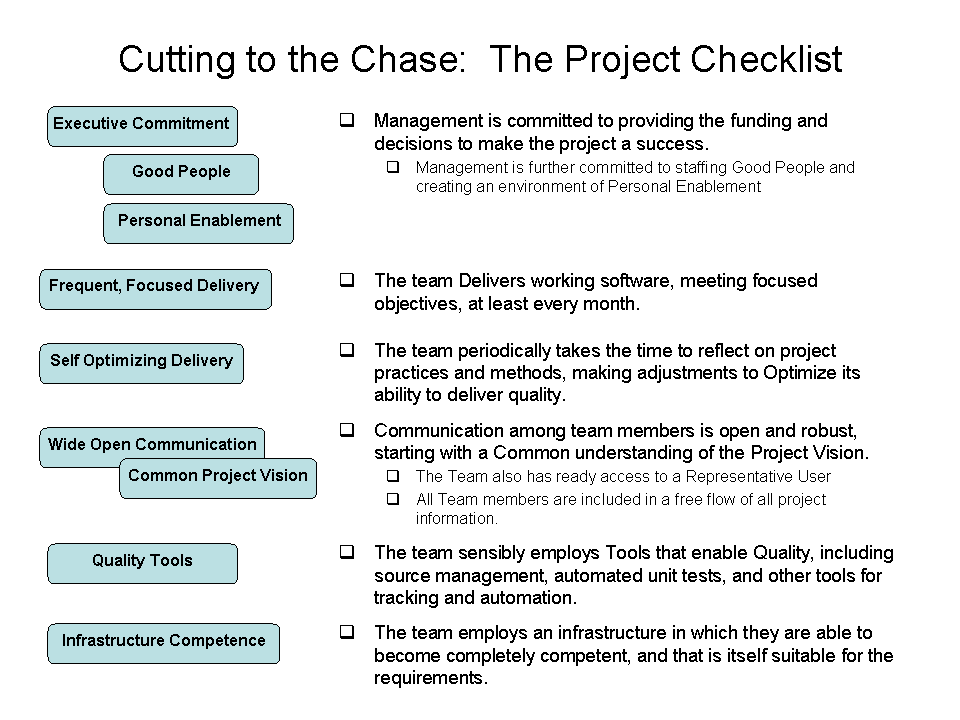
The preceding is a summary slide from a deck I am using to clarify my own approach to methodology. It is a synthesis of recommendations from the CHAOS report, Alistair Cockburn, and my own experience.
Essentially, I mapped out the lists of "main things," or critical success factors, provided by CHAOS and Mr. Cockburn, and also made my own list. Then I went through an exercise of correlating and consolidating. This is where I ended up.
I think this checklist provides a concise, strategic guide for improving a project's chance of success. More useful still would be individual guides that provide tactical guidance for each of these, probably mapped against key project variables (like Alistair's team size and safety). I'll get right on this in my free time.
I also think it would be interesting to check this list against other similar lists from other modern methodologies like RUP, XP, etc. Rhythm, presented to the DJUG by Brian Boelsterli, looks like an interesting framework that might also have similar factors to consider.
Friday, September 09, 2005
Rapid Prototyping and Development--Options
In this post, I continue my analysis of rapid prototyping for Java Web apps. I see a few essential ingredients necessary for rapid prototyping:
- Fast and simple development of pages and page flow: must be able to easily create pages, get parameters from a submission, do business stuff, go to the next page, and present dynamic data--without manually touching 12 different files.
- Automation of basic CRUD activities: Even in complex apps, so much code fits a basic CRUD template. It is extremely helpful to be able to automate the first cut at this, by specifying model information once in the database, the code, or a neutral spec.
- Quick develop/run cycles: If it takes 45 seconds to see a change to the width of a text field, rapid prototyping is in trouble.
- Extensibility: Whatever cool automatic stuff is done for us, we need to be able deviate from the happy path and customize stuff.
- Anything else I am missing?
Are there Java technologies that allow developers to skip the enterprise stuff initially, and add it in later with a little refactoring?
- JSPs with code in the pages (or Velocity templates w/out the MVC, etc.): Good for 1 & 3, but ignores 2.
- IDE / Graphical tools: E.g. Java Studio Creator (is there a comparable Eclipse plugin?).
- Rife framework:
- Trails framework:
- Model Driven tools: I looked at AndroMDA a while back, and I don't remember it striking me as a tool for rapid prototyping. But it is probably worth another look. Since I started this post, I have come across Gorilla Logic, which looks very intriguing.
Are non-Java tools, e.g. Ruby/RAILs, that allow for development that is so inexpensive that we are willing to throw the prototype away?
- RAILS claims a 10x productivity advantage over J2EE, and judging by their demo it is at least that. So even if Ruby CGI is insufficient for Enterprise requirements, you can create a throw-away that is worth the effort.
To Be Continued...
Rapid Prototyping and Development--Questions
I've been thinking again about rapid prototyping and RAD tools for Web development. Perhaps it is because I have been working with Enterprise apps for a few years, with their focus on hard-core non-functional requirements (security, scalability), but I don't see much going on anymore. It seems to me that J2EE, and the various Java frameworks, are so focused on robustness and maintainability that rapid prototyping is nearly impossible.
In the wild and whacky early days of Web development, it seemed that we got the functional requirements right, but then endured hell when our applications didn't perform or missed the mark on non-functional requirements. Why? Because we did very minimal requirements and immediately dived into scripting pages, essentially rapid prototyping. Now, as I see it, the Web world has inverted this situation: we have to do more requirements because it is more expensive to get working code in front of the user, but the technologies are more robust. I contend that, in general, it has become more difficult to get the functionality right, and that we now have applications that are often over-engineered.
I'd like to figure out how to re-introduce rapid prototyping into the realm of Java Web development. Here is what I think I need to figure out:
In the wild and whacky early days of Web development, it seemed that we got the functional requirements right, but then endured hell when our applications didn't perform or missed the mark on non-functional requirements. Why? Because we did very minimal requirements and immediately dived into scripting pages, essentially rapid prototyping. Now, as I see it, the Web world has inverted this situation: we have to do more requirements because it is more expensive to get working code in front of the user, but the technologies are more robust. I contend that, in general, it has become more difficult to get the functionality right, and that we now have applications that are often over-engineered.
I'd like to figure out how to re-introduce rapid prototyping into the realm of Java Web development. Here is what I think I need to figure out:
- I see a few essential ingredients necessary for rapid prototyping: Fast and simple development of presentation code, automation of basic CRUD activities, and quick develop/run cycles. What else?
- Are there Java technologies that allow developers to skip the enterprise stuff initially, and add it in later with a little refactoring?
- Are non-Java tools, e.g. Ruby/RAILs, that allow for development that is so inexpensive that we are willing to throw it away?
Monday, August 15, 2005
Java Exception Prescription
What are truly the best practices for using Exceptions in Java? Should checked exceptions be the norm? How should the Exception classes be structured? In this posting I attempt to achieve a personal approach to using Exceptions.
In Handling Exceptions from the Sun Java Tutorial, stresses the use of checked exceptions:
In Handling Exceptions from the Sun Java Tutorial, stresses the use of checked exceptions:
If a client can reasonably be expected to recover from an exception, make it a
checked exception. If a client cannot do anything to recover from the exception,
make it an unchecked exception
Sun's view is probably the excepted wisdom. But some leading Java guys are rethinking this, like Alan Griffiths, Bruce Eckle, and Rod Johnson.
Code written using checked exceptions tends to exhibit a couple of problems: catch clauses are often stubbed out for expediency, leading to "swallowed" exceptions. Also, all calling code ends up bloating with handling for errors that the caller may not want/need to handle.
Why not let callers catch what they want, otherwise let the error propogate up the chain? Rod defines the following rule of thumb from when to use a checked exception:
Should all callers handle this problem? Is the exception essentially a second return value for the method?
For Example,
I seems to me right now that this is the way to go. Basically, throw checked if the caller can and should do something about it, otherwise throw unchecked.Spending limit exceeded in a processInvoice() method
Wednesday, August 10, 2005
Looking at Spring
I have found that I can no longer resist the Spring Framework. Having been beguiled by its popularity and intrigued by its principals, I have decided to spend some time checking it out. The following chronicles my findings.
First, I am really interested in some of the underlying design goals, for which I turn to Chapter 4 of Rob's book, at the ServerSide. Spring aside, this is just a great essay on OO design.
So far I am impressed. Dependency Injection is just too sensible, and makes TDD much more practical.
To Be Continued...
First, I am really interested in some of the underlying design goals, for which I turn to Chapter 4 of Rob's book, at the ServerSide. Spring aside, this is just a great essay on OO design.
So far I am impressed. Dependency Injection is just too sensible, and makes TDD much more practical.
To Be Continued...
Monday, August 08, 2005
Shameless Promotion 3: John in a Nutshell
I am a software development expert who can contribute directly to successful application development, and also make broader contributions to an organization's success:
- I know how to develop software with maximum value for any timeframe and budget.
- I am a versatile professional who can fulfill many roles... roles often requiring several resources.
- I am a highly productive contributor, I can get solutions done quickly.
Hands-on development is my foundation, but I have also worked hard to hone strong business skills: I have an MBA, several years of line and technical project management experience, and polished communication skills. I have led technical teams of 10 people, departments of around 20, and have countless hours interacting with Clients at all levels.
Encompassing both my technical and business skill sets is an overarching expertise in software development. This expertise is what enables me to deliver maximum value for any timeframe and budget. My unique combination of skills allows me to add strategic thinking and decision-making on top of a concrete, in-depth understanding of technology. This combination is also what enables me to fulfill so many roles; from developer to architect to resource manager and more.
My Resume and generic Cover Letter describe my skills in much more detail.
In terms of full-time positions, my mix of skills probably best matches a Principal Engineer, Architect, or Lead role with a small software company or consultancy. I am also very open to freelance work, where I can deliver on projects of all sizes. On top of software design and development, I can fulfill many of the crucial needs of a successful project:
Planning, staffing, defining team structure and roles, scoping, defining development process and tools, prototyping, and architecture.
As a consultant, I must always keep an eye out for the next gig. I'd love to discuss potential opportunities, whether in the planning stage or thereafter, Lead, freelancer, or other key role. If you are interested in someone like me, drop me a line.
- John Troxel
Denver, Colorado
Shameless Promotion 2: John's Resume
Objectives
Opportunities to help companies outperform their competition with pragmatic software solutions.
To leverage my unique software engineering expertise and deliver effective solutions.
To provide the leadership in analysis, architecture, design, and engineering necessary to successfully launch and scale software products.
To leverage my unique software engineering expertise and deliver effective solutions.
To provide the leadership in analysis, architecture, design, and engineering necessary to successfully launch and scale software products.
Skills Summary
- BS Computer Science, MBA / MIS with over 20 years of software development experience, specializing in Web-based applications
- Programming: Java, Javascript, Groovy, Ruby, C, Perl, JSP, Visual Basic, Python, Rails, Grails, AJAX, Spring, Maven, MySql, Oracle, MongoDB, Memcached, JBoss, Tomcat, Node.js
- Software engineering methodologies, processes, and tools: UML, Requirements Analysis and Management, Agile methods, Unified Process (RUP). Object design (OOAD), system and software architecture, Open Source, SCEA, SCJP, Rational Certified Consultant RUP/OOAD
- Technical line and project management, organization design, team mentoring
Freelance Software Developer and Architect -- August 2012 - Present
codecraft solutions LLC, Denver
- Execute custom design and development, Ruby, Groovy, Java, Javascript, and .Net
- Conduct software refactoring and system architecture improvements enabling better scale.
- Design and build mobile and single page apps using AngularJ, Ionic, and other JavaScript libraries.
- Grails framework customization, data import processing, ecommerce web UI
- Worked with clients including haughtcodeworks.com, The Trade Desk, and Deem.com
Senior Software Engineer -- September 2015 - June 2016
Reach150 Social, Los Altos
- Primary architect and developer for new hybrid mobile application
- Built platform and features using AngularJS, Ionic, Java, and Node.js tools
- Enhanced service API using Java, RESTEasy, and Spring tools
Partner & Senior Developer -- April 2015 - September 2015
Forefront Labs, Denver/Lincoln
- Partner and Sr. Consultant, developing custom applications
- Specialized in Rails, mobile, and customer engagement
Software Consultant -- July 2013 - March 2015
Flickr/Yahoo, San Francisco
- Refactored core Java middleware components for increased stability and maintainability
- Revamped entire caching infrastructure: implemented Twitter twemproxy as a key platform component and integrated across hundreds of PHP and Java hosts
- Enhanced the continuous delivery process spanning several technologies including Python, Perl, and PHP
Principal Software Engineer -- March 2011 – July 2012
Rearden Commerce, Foster City, California
- Key architect and developer for content integration tools using Spring Batch, Camel, and custom tools.
- Lead developer for a custom content curation system in Grails.
Senior Software Engineer -- January 2008 – March 2011
- Senior contributor to common Ajax and UI components.
- Developed Endeca faceted search applications and data-processing tools.
- Enhanced in-house MVC framework using Javascript and Java.
- Contributed to design and development of new UI framework using Spring MVC.
Freelance Software Developer & Architect -- June 2006 – December 2008
- Lead all development efforts for BuyBak.com--an eCommerce startup providing reverse logistics capabilities--using Java, Struts, Spring, iBatis, Grails, as well as Ruby and MySQL.
- Developed the system architecture and design (UML domain model, site map, etc.) for start-up healthcare service.
- Developed Ruby on Rails, Javascript, and Java code to create a digital video system inside a Web-based, Ajax-style email system (Zimbra).
Sr. Software Engineer -- March 2005 – June 2006
McKesson (System Engineering Services), Denver, ColoradoJava software design and development for mission critical applications.
- Development key internal application using Java, Tomcat, XSLT, and AJAX
- Development of all Web Service interfaces to the core system using JbossWS
- Development of core components using JMX on JBoss
Sr. Java Developer; Sr. Systems Analyst -- March 2004 – March 2005
Veteran’s Administration (Express Management Solutions), Denver, ColoradoMajor contributor to critical systems development for the Health care Administration Center.
- Leading establishment of System Analysis discipline and spearheading analysis of major initiative
- Key team contributor for software architecture and programming for Oracle 9i and STRUTS
Developer; Product Manager -- June 2002 – March 2004
Grizella Corporation, Lakewood, ColoradoDeveloper of Web-based products for a Transportation software company.
- Architecture and programming for service-oriented system using Tomcat/Java Servlets/JSP
- Developed an e-commerce ordering application with a credit card gateway interface
- Created Web application to effectively utilize resources for a major Trucking association
- Created a Web UI framework (MVC) for rapid development of Web-based services
Experio Solutions, Denver, Colorado
Manager of technical project teams.
- Project Manager for a critical process re-engineering of the IT department of a major utility
- Developed components and workflows for a business service model using SeeBeyond
- Contributed to J2EE and Enterprise Application Integration interest groups
- Attended TIBCO training and maintained a Web-based InConcert demo
iXL, Denver, Colorado
Various Management roles for Denver office of iXL.
- Managed departments of up to 18 reports: Technical Services, Quality Services, Requirements Management
- Successfully implemented improved Requirements Management and Change Request Management processes as Chair of Denver office best practices taskforce
- Defined the corporate methodology framework utilizing RUP principles as key member of Corporate Methodology Team
- Provided guidance to teams on program and project best practices
iXL, Denver, Colorado
Leader of technical development group for a top Internet-based business solutions company.
- Managed technical teams of up to 10 developers, from requirements through deployment, for Budget Rent-a-Car, National Processing Corporation, and American Water Works Association
- Lead Architect and Developer for ServletExec/NES/Oracle and IIS/SQL Server/ASP projects
- Created and managed Technical Requirements and Architecture documents using Use-case specifications and realizations, sequence diagrams, and Deployment diagrams
- Technical Project Management and primary technical interface with high-level Client management and vendor partners
iXL (Green Room Productions), Sausalito, California
Leader of Web application development for a successful Web development company.
- Established and managed the Engineering Services team, that grew to 17 employees
- Internet application projects for travel clients including Sheraton Hotels, Walt Disney World, Travelocity, Mountain Travel Sobek, and Abercrombie and Kent
- Developed interactive Web applications using Perl, Server-Side JavaScript (SSJS), Oracle, ASP, and MS SQL Server
- Led development of Web-based Workflow system, including project, assignment, and hours tracking
Visual Movement Corporation, Denver, Colorado
Internship with a software development team specializing in the transportation industry.
- Technology selection and market research, implementation of installation utility in Visual Basic
Cooper & Chyan Technology, Inc., Cupertino, California
Integral member of software engineering team for a start-up CAD software company.
- Directed the design and content of a successful new GUI for an advanced CAD system
- Maintained and enhanced a run-time graphics library using C, Motif, and X-Windows. This library was used to build the GUI listed above
MBA / MIS. University of Denver (Daniels College of Business) June 1996
· GPA: 3.51 / 4.00
· Member of Information Technology Association and charter member of Toastmasters
B.S. Computer Science. Colorado State University May 1991
· Active member of Sigma Alpha Epsilon Fraternity. Vice President, Alumni Chairman
Certifications
· Sun Certified Enterprise Architect for J2EE, November 2003
· Sun Certified Java Programmer, December 2001
· Rational Certified Consultant in RUP and OOAD, March 2002
Shameless Promotion 1: John's "Cover Letter"
I am a professional software engineer and manager, and my expertise in software development can improve the success of software projects. I have over 11 years experience in software development as a leader and a key contributor in several roles.
I am a leader who can code, and a developer who can manage people and projects. I believe I have a truly unique breadth of skills that make me an indispensable asset to software development projects:
- Technical lead, architect, and developer on dozens of projects, including large engagements for clients like Sheraton Hotels, Travelocity, Budget Rent-A-Car, and the Veteran's Administration
- Sun Certified Architect for J2EE
- Programming experience in Java (4 years), C (3), VB/ASP (3), and Perl (2)
- Sun Certified Java Programmer
- Effective, hands-on skills as a software engineer, architect, and business/systems analyst
- Several years of experience as an engineering line manager and as a technical project manager
- Rational Certified Consultant in RUP and OOAD
- MBA and a Bachelor's in Computer Science
Please let me know if you would like a current resume, or to discuss how I can help you to succeed. Sincerely,
John Troxel
303.667.3280
Subscribe to:
Posts (Atom)